Questions that once lived in the realm of speculation about artificial intelligence (AI) are unfolding as legal realities.
On December 11, 2025, the Walt Disney Company (“Disney”) announced a $1 billion equity investment in OpenAI.1[1]OpenAI, The Walt Disney Company and OpenAI reach landmark agreement to bring beloved characters from across Disney’s brands to Sora, https://openai.com/index/disney-sora-agreement/ (last visited Jan. 23, 2026). While the precise terms of the agreement remain undisclosed, public statements from Disney and OpenAI indicate that Disney will grant OpenAI a three-year license to generate content using certain animated characters and associated elements from Disney, Marvel, Pixar, and Star Wars, including costumes, props, vehicles, and environments.2[2]Id. According to the announcement of the deal, the agreement authorizes OpenAI’s text-to-video generation tool, Sora, to produce user-prompted videos incorporating this licensed intellectual property, and permits ChatGPT Images, OpenAI’s chatbot, to generate images using the same IP.3[3]Id.
Artificial intelligence presents a double-edged sword in the context of intellectual property, promising greater efficiency while raising significant concerns. The Copyright Alliance reports more than fifty AI-related infringement lawsuits filed within the past few years.4[4]Mid-Year Review: AI Copyright Case Developments in 2025, Copyright Alliance (Aug. 21, 2025), https://copyrightalliance.org/ai-copyright-case-developments-2025/. The Disney–OpenAI licensing agreement illustrates one path studios may take to protect their intellectual property from unauthorized use on generative AI platforms. This approach, does not eliminate the broader issue; rather, it only mitigates Disney’s potential infringement risks within OpenAI’s ecosystem. Thus, Disney and similarly situated studios, as well as rights holders without the leverage to secure comparable agreements, remain exposed to the same copyright and misappropriation risks across emerging AI platforms.
In light of this, the question becomes whether generative AI platforms that operate without licenses or authorization incur copyright liability when they train their models on copyright protected works and generate outputs that resemble those works, or whether such practices fall within the scope of fair use or platform liability immunities.
I. The Modern Day Betamax
In 1975, when Sony introduced the Betamax videocassette recorder, it revolutionized how consumers interacted with media by allowing them to record and replay television content at home for the first time. The innovation alarmed copyright holders of television programs and movies shown on TV, including Disney and Universal, who, in efforts to protect their works, sued Sony for contributory copyright infringement. See Sony Corp. of America v. Universal City Studios, Inc., 464 U.S. 417 (1984) (“Sony-Betamax”). In the Sony-Betamax case, the Supreme Court held that the sale of a copying device does not constitute contributory copyright infringement so long as the product is “capable of substantial noninfringing uses.”5[5]Sony Corp. of America v. Universal City Studios, Inc., 464 U.S. 417, 418 (1984). Because the Betamax VCR allowed consumers to record television for later viewing at home, its private, noncommercial “time-shifting” nature did not pose significant harm to the potential market and qualified as fair use.6[6]Id.
The Sony-Betamax decision marked a paradigm shift in copyright law, reshaping how courts evaluate new technologies that facilitate copying. Today, generative artificial intelligence presents a similar inflection point, though on a far broader scale. Unlike the private, analog copying of the Sony-Betamax era, AI software can produce works digitally, distribute them globally, and may monetize their services commercially. The tension between copyright and new technology has reemerged as AI challenges the very foundation of U.S. copyright law, which is premised on human authorship, granting copyright holders the exclusive rights to reproduce, distribute, and prepare derivative works under 17 U.S.C. § 106.7[7]U.S. Copyright Office, What Is Copyright?, COPYRIGHT.GOV, https://www.copyright.gov/ (last visited Oct. 1, 2025).
These issues are exemplified in copyright infringement actions filed in 2025 by Disney, Universal, and Warner Bros. against the subscription-based artificial intelligence platform, Midjourney, Inc. (“Midjourney”). Within months, those cases were consolidated in the Central District of California under Disney Enterprises, Inc., Universal City Studios Productions LLLP, Warner Bros. Entertainment Inc., et al. v. Midjourney, Inc.
Midjourney’s platform generates images and videos from user-initiated text prompts, providing users without traditional design skills a tool to create customized digital art through a diffusion-based generative AI model.8[8]Alexa Kayman & Etienne Segal, Midjourney Business Breakdown & Founding Story, Contrary Research (May 23, 2025), https://research.contrary.com/company/midjourney. Diffusion models operate by adding Gaussian noise to an image until the original picture becomes nearly unrecognizable.9[9]Robin Rombach et al., High-Resolution Image Synthesis with Latent Diffusion Models, CompVis LMU Munich (last visited Jan. 25, 2026), https://ommer-lab.com/research/latent-diffusion-models/. The model then learns to reverse this process by removing the noise through a step-by-step denoising sequence.10[10]Id. By repeating this process across millions of images, the system learns how shapes, colors, and patterns combine to form recognizable objects.11[11]Id. Once trained, the model can start with pure noise and reconstruct a new image based on the patterns it learned, which is why the same prompt can produce multiple similar but distinct outputs.12[12]Id. In short, diffusion models enable systems like Midjourney to generate new images by learning from vast collections of existing ones: before the system can create an image of “a cat driving a car,” it must first learn what cats and cars look like from prior examples.13[13]Id.
Midjourney’s platform also has an “Explore Page” that curates a personalized feed of images and videos of other content the platform has generated for other subscribers.14[14]Personalized Feeds and Midjourney TV, Midjourney Updates (last visited Nov. 26, 2025), https://updates.midjourney.com/personalized-feeds-and-midjourney-tv. Midjourney’s services are offered through tiered subscription plans ranging from $10 per month to $120 per month; the more the subscriber pays, the more content the user can generate in shorter periods of time.15[15]Alexa Kayman & Etienne Segal, supra note 4.
Since the software’s launch in February of 2022, the company generated approximately $200 million in revenue in 2023 and $300 million in 2024, with nearly 21 million users.16[16]Id. The platform’s ability to generate potentially infringing content (and profit from it) at such a scale has prompted significant concern for studios and copyright holders, particularly in the entertainment industry, who invest significant capital, resources, and time in developing and licensing their intellectual property.
On June 11, 2025, Disney Enterprises, Inc., Marvel Characters, Inc., MVL Film Finance LLC, Lucasfilm Ltd. LLC, Twentieth Century Fox Film Corporation, Universal City Studios Productions LLLP, and DreamWorks Animation L.L.C. (collectively “Disney” and “Universal”) filed a complaint against Midjourney alleging direct and secondary copyright infringement.17[17]Disney Enterprises Inc., v. Midjourney, Inc., Case No. 2:25-cv-05275-JAK-AJR. Likewise, but in a separate action, on September 4, 2025, Warner Bros. Entertainment, Inc., DC Comics, Turner Entertainment Co., Hanna Barbera Productions, Inc., and The Cartoon Network, Inc. (collectively “Warner Bros.” or “Warner”), also filed a complaint against Midjourney alleging direct and secondary copyright infringement.18[18]Warner Bros. Entertainment Inc. v. Midjourney, Inc., No. 2:25-cv-08376 (C.D. Cal. filed Sept. 4, 2025) (Complaint). Warner seeks statutory damages of up to $150,000 per infringed work under 17 U.S.C. § 504 and injunctive relief preventing further use of its copyrighted material.19[19]Id. ¶ 185. On October 7, 2025, Midjourney filed its answer to Warner’s complaint raising seven affirmative defenses: fair use under 17 U.S.C. § 107, lack of standing, licensed use of the asserted works, plaintiffs’ own contribution to one or more of the alleged images, the doctrine of unclean hands, de minimis use, and protection under Section 512 of the Digital Millennium Copyright Act (DMCA).20[20]Warner Bros. Discovery, Inc., et al., v. Midjourney, Inc., No. 2:25-cv-08376-JAK-E (C.D. Cal. filed Oct. 7, 2025) (Answer).
As of November 4, 2025, Disney, Universal, and Warner’s lawsuits were consolidated pursuant to Federal Rule of Civil Procedure 42(a), now proceeding under Disney Enterprises, Inc., Universal City Studios Productions LLLP, Warner Bros. Entertainment Inc., et al. v. Midjourney, Inc., Case No. 2:25-cv-05275-JAK-AJR. This consolidated action now stands as one of the first major tests of how copyright law applies to generative artificial intelligence.
II. Direct and Secondary Copyright Infringement
In Warner’s complaint, Warner alleges Midjourney is liable for direct and secondary copyright infringement, arguing that the platform used its copyrighted materials without authorization to train its AI model and enables its users to generate infringing outputs.21[21]Warner Bros., No. 2:25-cv-08376 (Complaint).
Direct Copyright Infringement
Direct copyright infringement occurs when a party violates one or more of the exclusive rights granted to a copyright holder, such as the right to reproduce and distribute the copyrighted works, or prepare derivate works under 17 U.S.C. § 106. Warner contends that Midjourney, through its own affirmative conduct, “directly reproduces, publicly displays, and distributes infringing reproductions and unauthorized derivative works” of Warner’s copyrighted content.22[22]Id. ¶ 72. According to Warner, Midjourney trained its AI model on copyrighted datasets by downloading, reformatting, and sorting Warner-owned content in a manner constituting “copies” under § 101.23[23]Warner Bros. Compl. ¶ 98; 17 U.S.C. § 101 (“‘Copies’ are material objects, other than phonorecords, in which a work is fixed by any method now known or later developed, and from which the work can be perceived, reproduced, or otherwise communicated, either directly or with the aid of a machine or device.”). Warner alleges that Midjourney not only makes these outputs available for download, but also features Warner-owned characters in promotional materials, thereby creating unlicensed derivative content and potentially implying a false endorsement.24[24]Warner Bros. Compl. ¶ 14.
A key question turns on to whether Midjourney engaged in volitional copying; meaning that Midjourney, not its users, initiated the act to be held liable for direct infringement. Because users supply prompts that trigger the system to generate outputs, Midjourney may argue that the platform functions as a passive tool performing automated, user-initiated tasks. By contrast, the training phase, where Midjourney allegedly ingests and copies millions of copyrighted works without user involvement, presents a stronger basis for direct infringement because the copying is allegedly unlicensed and initiated by the platform itself.
Secondary Copyright Infringement
Secondary liability applies to a defendant who does not directly infringe but is held responsible for facilitating, encouraging, or profiting from another’s infringing acts.25[25]Sony, 464 U.S. at 437-438. Two principal theories govern secondary liability: contributory infringement and vicarious liability.26[26]See Metro-Goldwyn-Mayer Studios Inc. v. Grokster, Ltd., 545 U.S. 913, 125 S.Ct. 2764, 162 L.Ed.2d 781 (2005) (holding that a person who distributes a device accompanied by a clear expression that it’s intended to foster infringement can be liable for resulting acts of infringement by third parties.).
Midjourney may be held contributorily liable if Warner demonstrates that Midjourney had knowledge of infringing activity and induced, caused, or materially contributed to the infringing conduct of another.27[27]Metro-Goldwyn-Mayer Studios, 545 U.S. at 913-914. Vicarious liability may be imposed if Midjourney had the right and ability to control the infringing activity and derived a direct financial benefit from the infringement.28[28]Sony, 464 U.S. 417 (1984); Metro-Goldwyn-Mayer Studios, 545 U.S. 913 (2005). Warner pleads both theories, and in either case, direct infringement is a prerequisite before secondary liability can attach.
Warner supports its allegations in its complaint with numerous examples of AI-generated images and videos produced by Midjourney in response to user-generated prompts which feature Warner’s copyrighted characters such as Batman, Bugs Bunny, and Tom & Jerry (see example below).29[29]Warner Bros. Compl. ¶ ¶ 73, 2.
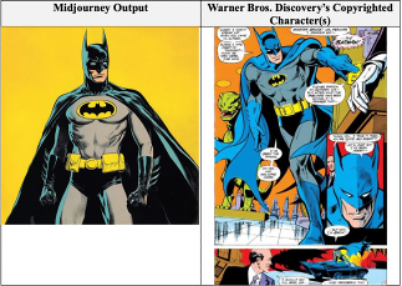
Image from Warner’s Complaint30[30]Id. ¶ 76.
Warner claims that Midjourney enables users to generate infringing outputs and unauthorized derivative works. Warner argues that the platform knew of and encouraged infringing activity by actively promoting its ability to generate such outputs on its “Explore Page,” which curates and displays AI-generated images, including allegedly infringing outputs (see example below).31[31]Warner Bros. Compl. ¶ ¶ 70, 133-134. In addition to this, Warner further argues that the platform profited from such infringement due to their subscription-based revenue model.32[32]Id.
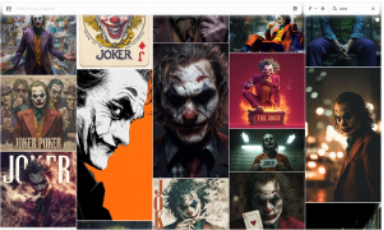
Image from Warner’s Complaint (showing Midjourney’s “Explore Page”)33[33]Id. ¶ 133.
Together, these allegations form the basis of Warner’s secondary liability claim suggesting that Midjourney not only facilitated but also financially benefits from the infringement occurring across its platform.
III. The Fair Use Doctrine: Training AI and Expressive Outputs
As part of its defense, Midjourney asserts fair use; one of the primary doctrines that mediates the tension between innovation and copyright protection.34[34]Warner Bros. Discovery v. Midjourney, No. 2:25-cv-08376-JAK-E (Answer). The fair use doctrine allows the limited use of copyrighted material without the copyright owner’s consent for the purposes of criticism, commentary, news reporting, teaching, scholarship, or research.35[35]17 U.S.C. § 107. To determine whether a particular use qualifies, courts consider the following four fair use factors: (1) the purpose and character of the use, (2) the nature of the copyrighted work, (3) the amount used in relation to the copyrighted work, and (4) the effect of the use upon the potential market for the work.36[36]Id. § 107
Training AI on Copyrighted Content
The first factor, the purpose and character of the use, often hinges on whether the secondary use is transformative, that is, whether it “adds something new, with a further purpose or different character, altering the first with new expression, meaning, or message.”37[37]Campbell v. Acuff-Rose Music, Inc., 510 U.S. 569, 579 (1994). Ingesting copyrighted materials to train AI models may be transformative when its purpose is not to substitute for the expressive use of the original works, but to extract statistical patterns enabling the system to generate outputs in response to text prompts.38[38]Authors Guild v. Google, Inc., 804 F.3d 202, 209-210 (2d Cir. 2015). The Second Circuit adopted this reasoning in Authors Guild v. Google, Inc., (“Google Books”), where the court found that scanning copyrighted books to create a searchable index was considered transformative because it created an entirely new information tool rather than competing with the market for the books themselves.39[39]Id.
Midjourney, citing Kadrey v. Meta Platforms Inc., 788 F. Supp. 3d 1026 (N.D. Cal. 2025) and Bartz v. Anthropic PBC, 787 F. Supp. 3d 1007 (N.D. Cal. 2025), argues that the ingestion of copyrighted works to train AI models is a “quintessentially transformative” act.40[40]Warner Bros., No. 2:25-cv-08376-JAK-E (Answer). In Bartz, a group of authors brought a class action suit claiming Anthropic acquired their works and used them to create a massive archive to train its AI model, infringing upon the author’s copyrights.41[41]Bartz v. Anthropic PBC, 787 F. Supp. 3d 1007 (N.D. Cal. 2025). Likewise, in Kadrey, thirteen authors allege Meta trained its models on their copyrighted works and its outputs flooded the market with competing substitutes, causing market dilution.42[42]Kadrey v. Meta Platforms Inc., 788 F. Supp. 3d 1026 (N.D. Cal. 2025).
Judge Chhabria, however, emphasized that his ruling in Kadrey (in favor of Meta) did not establish the lawfulness of Meta’s conduct but reflected the plaintiffs’ failure to develop an adequate evidentiary record.43[43]See Kadrey, 788 F. Supp. 3d at 1036-37 (Chhabria, J.) (“[T]his ruling does not stand for the proposition that Meta’s use of copyrighted materials to train its [large] language models [(LLM)] is lawful. It stands only for the proposition that these plaintiffs made the wrong arguments and failed to develop a record in support of the right one.”). Kadrey and Bartz illustrate the evidentiary burden in AI copyright litigation. In Kadrey, the plaintiffs claimed Meta’s language models “regurgitate” portions of their books but failed to present examples of outputs reproducing those works, leaving them unable to establish substantial similarity or market substitution.44[44]Id. Similarly, in Bartz, the court granted summary judgment for Anthropic because the plaintiffs failed to provide evidence of infringing outputs or market harm.45[45]Bartz, 787 F. Supp. at 1024-25.
Therefore, courts are more likely to rule against a fair use defense when plaintiffs establish a developed record of market harm and copyrighted works were used to train profit-generating models that produce competing outputs.46[46]Kadrey, 788 F. Supp. at 1036-37 (“No matter how transformative LLM training may be, it’s hard to imagine that it can be fair use to use copyrighted books to develop a tool to make billions or trillions of dollars while enabling the creation of a potentially endless stream of competing works that could significantly harm the market for those books”).
Midjourney’s Expressive Outputs
The character of Midjourney’s outputs may weaken a transformative finding. Unlike the noncommercial indexing project in Authors Guild v. Google, where the technology enabled users to search for and locate existing works and where the scanned works were not publicly distributed in their expressive form, Midjourney generates content that, as reflected in Warner’s complaint, may closely resemble copyright-protected characters and other protected expression.47[47]Warner Bros. Compl. ¶ 76. According to Warner, when prompted to generate Batman or Scooby-Doo, the system produces expressive outputs that substitute for the kind of licensed derivative works Warner owns.48[48]Warner Bros. Compl. ¶ ¶ 6, 150.
The Supreme Court has been reluctant to find fair use when secondary use supplants the market for the original or its authorized derivatives.49[49]See Andy Warhol Foundation v. Goldsmith, 598 U.S. 508, 511 (2023) (“if an original work and secondary use share the same or highly similar purposes, and the secondary use is commercial, the first fair use factor is likely to weigh against fair use, absent some other justification for copying.”). In Andy Warhol Foundation v. Goldsmith, the Supreme Court rejected a fair use defense because Warhol’s silk-screened image of Prince had the same commercial purpose as Lynn Goldsmith’s original photograph.50[50]Id. at 513. In Midjourney’s case, one could argue that its outputs compete in the same commercial markets as the original works. The platform, however, would likely argue that those outputs are generated as a result of the user’s independent choices when entering prompts.
Ultimately, courts evaluate fair use on a case-by-case analysis where outcomes are fact-specific based upon the underlying circumstances.51[51]U.S. Copyright Office, Fair Use Index (last updated Aug. 2025), https://www.copyright.gov/fair-use/. Overall, a court may view Midjourney’s training practices as transformative, consistent with Google Books, but its outputs as infringing, consistent with Warhol v. Goldsmith, if the court finds that the outputs do in fact compete in the same market as the copyrighted works.
While innovation should be encouraged, it also warrants protection. If courts permit companies to profit from producing unlicensed AI-generated outputs that replicate protected expression without consequence, licensees may have less incentive to pay for authorized uses, which risks diminishing the economic value of the underlying rights. This type of indirect market harm is precisely what the first and fourth fair use factors are designed to address.
IV. Platform Liability or Immunity
As part of its defense, Midjourney invokes protection under Section 512 of the Digital Millennium Copyright Act (DMCA). Enacted in 1998, the DMCA shields online service providers from monetary liability for user-generated copyright infringement by creating “safe harbors” that shift the burden of detecting infringing content onto copyright holders.52[52]U.S. Copyright Office, The Digital Millennium Copyright Act (last updated Oct. 2023), https://www.copyright.gov/dmca/.
Under 17 U.S.C. § 512( c )(1)(A), a service provider is eligible for safe harbor protection if it (1) lacks actual knowledge of the infringing activity, (2) absent such knowledge, is not aware of “red flag” facts or circumstances making infringement objectively apparent, or (3) upon obtaining such knowledge or notice, acts “expeditiously” to remove or disable access to the infringing material.53[53]Id.
As the Second Circuit explained in Viacom International v. YouTube, safe harbor protections are not forfeited merely because a platform has general awareness; rather, they are lost when the provider has actual or red-flag knowledge of specific infringing material and fails to remove it.54[54]Viacom International, Inc. v. YouTube, Inc., 676 F.3d 19, 31-35 (2d Cir. 2012). In Viacom, YouTube was sued for direct and secondary copyright infringement after users uploaded unlicensed clips of Viacom-owned programs, yet the court held that YouTube remained eligible for § 512 immunity because it lacked knowledge of particular infringing items. Thus, while a service provider may not act willfully blind to infringement, widespread infringement alone does not defeat § 512 protections.
Midjourney’s § 512 defense therefore turns onto the extent to which the platform had actual or red-flag knowledge of the infringement.55[55]Warner Bros. Discovery, v. Midjourney, No. 2:25-cv-08376-JAK-E (Answer). Although Viacom held that general awareness of infringement is insufficient to defeat § 512 immunity, Midjourney’s platform may be distinguishable from YouTube in Viacom. YouTube’s infringement risk stemmed from user-uploaded content, whereas Midjourney is generating the content at issue, blurring the lines between a platform hosting content (like YouTube) and being a co-creator of content.
While Midjourney will likely frame itself as a neutral tool through which users independently generate outputs by entering prompts, the design of the platform could complicate that defense. According to Warner, the Explore Page functions as a way to market its service and encourage existing subscribers to generate more content.56[56]Id. This feature may support the notion that Midjourney is more than merely a host for user content. Nonetheless, if Midjourney can demonstrate that the algorithm selects and displays material autonomously, without human oversight or editorial involvement, it may contend that it lacks the specific knowledge necessary to forfeit the DMCA’s liability shield.
This issue underscores a broader, unresolved question about the role online platforms play in the internet shaped by algorithmic curation; namely, whether a platform that selects, organizes, or promotes user-generated content remains a passive host or instead becomes an active participant in the creation and dissemination of that content. Similar to the debates surrounding Section 230 of the Communications Decency Act, the challenge here is identifying the point at which a platform’s design and curation choices shift it from neutral intermediary to co-creator or publisher, an inflection point that may fundamentally alter platform liability.
V. Effect of Use on the Potential Market
Midjourney’s lawsuit highlights the unknown boundaries of copyright law where Courts confronting this intersection must apply longstanding doctrines to unprecedented new technologies. While the Disney-OpenAI licensing agreement illustrates a strategy studios may take to ease infringement risks, the approach does not eliminate the broader problem for all rights holders, many of which do not have the same type of leverage to negotiate such deals.
Cases like Sony-Betamax recognize that technological innovation should not be stifled when it serves substantial noninfringing purposes. Yet, Warhol v. Goldsmith, Kadrey, and Bartz, illustrate the notion that fair use cannot justifiably permit outputs that compete with the expressive value of the original copyrighted work. Midjourney exemplifies this tension. If its expressive outputs do not compete in the market for the original works, its training practices may resemble the transformative, intermediate use approved in Google Books. When those outputs do compete in the same markets, however, the analysis shifts toward the market-substitution concerns emphasized in Warhol v. Goldsmith.
The economic pressure cuts both ways. Studios may wish to adopt AI tools to reduce costs, yet widespread AI adoption threatens to displace human artists and devalue licensed intellectual property. When AI companies market their tools directly to commercial creators, they compete with the artists studios would traditionally compensate. Further, studios compensate artists for creative contributions under legal and contractual obligations, whereas AI platforms that “learn” from those works bear no comparable responsibility. If AI platforms are lawfully permitted to use copyrighted works in this manner, AI-generated content risks substituting for licensed works.
This market disruption is particularly acute in the entertainment industry, where studios invest millions of dollars to create and license valuable intellectual property under strict contractual frameworks, and licensees pay substantial fees for the right to make derivative works. If courts allow AI developers and users to reproduce copyrighted content without paying comparable licensing fees, the result could destabilize the licensing market, discourage existing licensees from continuing to pay, and erode the value of intellectual property.
The Disney–OpenAI licensing agreement reflects one strategy studios may take to reconcile this imbalance. However, for studios and rights holders without the leverage to negotiate comparable solutions, intellectual property remains exposed to the same risks.
The challenge, then, is not to punish technological development but to redefine accountability. One potential reform is to develop a compulsory licensing regime for training AI on copyrighted works modeled on the music industry’s framework under the Music Modernization Act. Such a system would not eliminate disputes, but it could establish a baseline of legality, compensation, and transparency, offering a more workable alternative to the current all-or-nothing litigation model. As AI reshapes creative markets, copyright law must evolve so that innovation does not come at the expense of the rights it was designed to protect.
Written by: Mackenzie Shane
Mackenzie is a 2026 J.D. Candidate at Brooklyn Law School.
Acknowledgement: I am especially grateful to Professor Marshall Silverman for his expert guidance and insightful comments on this piece.
1 OpenAI, The Walt Disney Company and OpenAI reach landmark agreement to bring beloved characters from across Disney’s brands to Sora, https://openai.com/index/disney-sora-agreement/ (last visited Jan. 23, 2026).
2 Id.
3 Id.
4 Mid-Year Review: AI Copyright Case Developments in 2025, Copyright Alliance (Aug. 21, 2025), https://copyrightalliance.org/ai-copyright-case-developments-2025/.
5 Sony Corp. of America v. Universal City Studios, Inc., 464 U.S. 417, 418 (1984).
6 Id.
7 U.S. Copyright Office, What Is Copyright?, COPYRIGHT.GOV, https://www.copyright.gov/ (last visited Oct. 1, 2025).
8 Alexa Kayman & Etienne Segal, Midjourney Business Breakdown & Founding Story, Contrary Research (May 23, 2025), https://research.contrary.com/company/midjourney.
9 Robin Rombach et al., High-Resolution Image Synthesis with Latent Diffusion Models, CompVis LMU Munich (last visited Jan. 25, 2026), https://ommer-lab.com/research/latent-diffusion-models/.
10 Id.
11 Id.
12 Id.
13 Id.
14 Personalized Feeds and Midjourney TV, Midjourney Updates (last visited Nov. 26, 2025), https://updates.midjourney.com/personalized-feeds-and-midjourney-tv.
15 Alexa Kayman & Etienne Segal, supra note 4.
16 Id.
17 Disney Enterprises Inc., v. Midjourney, Inc., Case No. 2:25-cv-05275-JAK-AJR.
18 Warner Bros. Entertainment Inc. v. Midjourney, Inc., No. 2:25-cv-08376 (C.D. Cal. filed Sept. 4, 2025) (Complaint).
19 Id. ¶ 185.
20 Warner Bros. Discovery, Inc., et al., v. Midjourney, Inc., No. 2:25-cv-08376-JAK-E (C.D. Cal. filed Oct. 7, 2025) (Answer).
21 Warner Bros., No. 2:25-cv-08376 (Complaint).
22 Id. ¶ 72.
23 Warner Bros. Compl. ¶ 98; 17 U.S.C. § 101 (“‘Copies’ are material objects, other than phonorecords, in which a work is fixed by any method now known or later developed, and from which the work can be perceived, reproduced, or otherwise communicated, either directly or with the aid of a machine or device.”).
24 Warner Bros. Compl.¶ 14.
25 Sony, 464 U.S. at 437-438.
26 See Metro-Goldwyn-Mayer Studios Inc. v. Grokster, Ltd., 545 U.S. 913, 125 S.Ct. 2764, 162 L.Ed.2d 781 (2005) (holding that a person who distributes a device accompanied by a clear expression that it’s intended to foster infringement can be liable for resulting acts of infringement by third parties.).
27 Metro-Goldwyn-Mayer Studios, 545 U.S. at 913-914.
28 Sony, 464 U.S. 417 (1984); Metro-Goldwyn-Mayer Studios, 545 U.S. 913 (2005).
29 Warner Bros. Compl. ¶ ¶ 73, 2.
30 Id. ¶ 76.
31 Warner Bros. Compl.¶ ¶ 70, 133-134.
32 Id.
33 Id. ¶ 133.
34 Warner Bros. Discovery v. Midjourney, No. 2:25-cv-08376-JAK-E (Answer).
35 17 U.S.C. § 107.
36 Id. § 107
37 Campbell v. Acuff-Rose Music, Inc., 510 U.S. 569, 579 (1994).
38 Authors Guild v. Google, Inc., 804 F.3d 202, 209-210 (2d Cir. 2015).
39 Id.
40 Warner Bros., No. 2:25-cv-08376-JAK-E (Answer).
41 Bartz v. Anthropic PBC, 787 F. Supp. 3d 1007 (N.D. Cal. 2025).
42 Kadrey v. Meta Platforms Inc., 788 F. Supp. 3d 1026 (N.D. Cal. 2025).
43 See Kadrey, 788 F. Supp. 3d at 1036-37 (Chhabria, J.) (“[T]his ruling does not stand for the proposition that Meta’s use of copyrighted materials to train its [large] language models [(LLM)] is lawful. It stands only for the proposition that these plaintiffs made the wrong arguments and failed to develop a record in support of the right one.”).
44 Id.
45 Bartz, 787 F. Supp. at 1024-25.
46 Kadrey, 788 F. Supp. at 1036-37 (“No matter how transformative LLM training may be, it’s hard to imagine that it can be fair use to use copyrighted books to develop a tool to make billions or trillions of dollars while enabling the creation of a potentially endless stream of competing works that could significantly harm the market for those books”).
47 Warner Bros. Compl.¶ 76.
48 Warner Bros. Compl.¶ ¶ 6, 150.
49 See Andy Warhol Foundation v. Goldsmith, 598 U.S. 508, 511 (2023) (“if an original work and secondary use share the same or highly similar purposes, and the secondary use is commercial, the first fair use factor is likely to weigh against fair use, absent some other justification for copying.”).
50 Id. at 513.
51 U.S. Copyright Office, Fair Use Index (last updated Aug. 2025), https://www.copyright.gov/fair-use/.
52 U.S. Copyright Office, The Digital Millennium Copyright Act (last updated Oct. 2023), https://www.copyright.gov/dmca/.
53 Id.
54 Viacom International, Inc. v. YouTube, Inc., 676 F.3d 19, 31-35 (2d Cir. 2012).
55 Warner Bros. Discovery, v. Midjourney, No. 2:25-cv-08376-JAK-E (Answer).
56 Id.