School Days: The Professionalization of the College Athlete
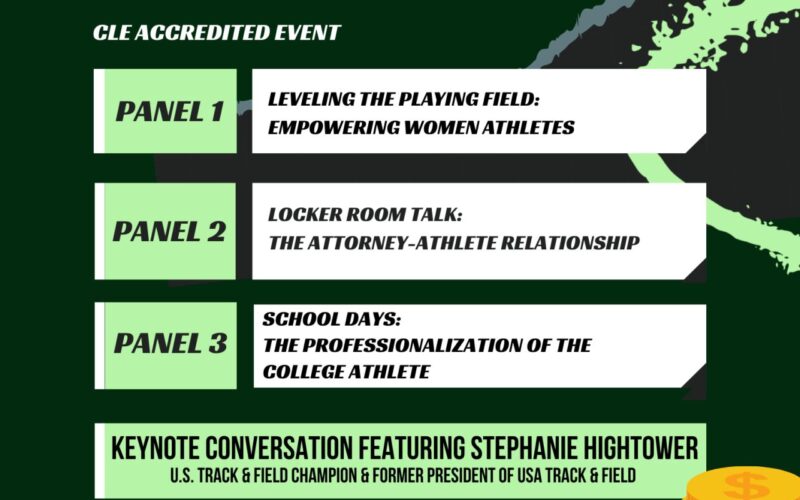
Brooklyn Law School’s Entertainment & Sports Law Society (BESLS) recently hosted its fifth annual Sports Law Symposium, themed “Athlete Inc.: Athlete as Entrepreneur,” examining how athletes are embracing their roles as business entities. The symposium featured multiple panels, including School Days: The Professionalization of the College Athlete, co-sponsored by Brooklyn Law School’s Intellectual Property Law Association (IPLA). The panel brought together an enthusiastic group of legal experts to explore the evolving and often uncertain landscape of the Name, Image, and Likeness (NIL) era in collegiate sports.
The panelists included Adam Dale, a sports, antitrust, and labor law attorney who was a key member of the House v. NCAA case that secured a $2.7B settlement of college athletes;1[1]House v. NCAA, 545 F. Supp. 3d 804 (N.D. Cal. 2021). Larry Fox, President of Shark Sports, licensed NBA agent since 1995, and General Counsel for Daymond John’s Shark Group; Tim Nevius, founder of Nevius Legal and former National Collegiate Athletic Association (NCAA) investigator who helped lead the NCAA v. Alston case to a Supreme Court victory;2[2]NCAA v. Alston, 594 U.S. 69 (2021). and Tara Sakraida Parker, CEO and Founder of Prime 1 Sports, the only female-owned NIL agency in the United States. The conversation was moderated by Dan Lust, a sports law attorney at Moritt Hock & Hamroff, professor at New York Law School, and host of the “Conduct Detrimental” podcast. Bringing his own background in athletic representation, Professor Lust navigated discussions on the rapidly changing landscape of college athletics, including contract negotiations, revenue sharing, and the future of athlete compensation.
The New NIL Landscape and the House Settlement
College athletics has seen a seismic shift due to recent legal developments surrounding NIL rights. Nevius observed that “college sports have been commercialized for a long time, and the only people who weren’t benefiting were the athletes.” The panelists traced the evolution from July 2021, when the NCAA eliminated rules prohibiting NIL deals, to the House settlement, which allows schools to pay athletes directly for the first time in history. This settlement allowed schools allocating a maximum of $20.5 million toward athlete compensation.
The settlement represents what Dale described as “a large first step in a further sustainable model,” though significant pain points remain. Athletes can now receive compensation from both their universities and unlimited outside deals with brands and collectives. However, third-party deals now require reporting through what Parker described as an “opaque” approval process with “inconsistent” decision-making. She noted that by some estimates, 70% of all deals would be denied under the current algorithm of NIL Go, a clearinghouse run by Deloitte for the College Sports Commission.
Power Imbalances and Contractual Challenges
A recurring theme throughout the panel was the way in which the dynamic between universities and student-athletes continues to remain unbalanced. Fox emphasized that, unlike the regulations and player associations seen in the professional leagues, “the space between college athletes and their universities is an uneven playing field.” College athletes are forced to navigate a dangerous arena where there are non-uniform contracts spanning over 20 pages with little regulatory oversight.
Fox described universities as acting predatorily, with institutions claiming students should just be “happy to be there.” The reality is that very few athletes have access to representation, and those who do often work with inexperienced agents. Families frequently discover too late that they have signed away significant rights, most popularly agreeing to liquidated damages provisions that require athletes to pay if they enter the transfer portal.
Parker drew a parallel to Wall Street, noting that these heavily lawyered contracts are being presented to kids and families who have never seen such documents. “It’s an unfair playing field,” she argued, particularly as schools increasingly shut down negotiations despite the antitrust settlement supposedly promoting competition. Nevius suggested that many of these issues could be more easily resolved with parties who better understand the landscape, advocating for dispute resolution mechanisms that allow confidential resolution rather than full-scale litigation, which can harm both athletes’ and universities’ reputations and future opportunities.
Future Challenges and Gray Areas
The panel addressed numerous complications in this new era of college athletics. International student visa restrictions present a significant hurdle, as student visas typically prohibit earning income. Fox explained the complicated workarounds currently being developed, including setting up LLCs and ensuring services are performed outside the U.S., with only licensing agreements occurring domestically.
Agent licensing presents another challenge, as representatives need licenses in every state where their clients compete. Professor Lust called for federal-level registry reform, noting that while New York is moving fast, these issues cannot be solved at the state level.
The influx of private equity investment into football and basketball programs emerged as what panelists called the biggest story in recent weeks. Nevius noted that not all schools are created equally, and he views the $20.5 million revenue-sharing cap from House not as a maximum, but a salary minimum. For schools in major conferences trying to compete in the arms race, private equity could fill critical funding gaps.
Perhaps most controversially, some NBA G League players have been granted college eligibility, further blurring the lines between amateur and professional athletics. This development, according to Nevius, highlights the tension between the commercialization and the academic mission at the heart of college sports.
Employee Status, Unionization, and Equity Concerns
The question of whether college athletes are employees was a central theme throughout the panel’s discussion. Dale noted significant impediments to unionization at the college level, particularly when schools refuse to acknowledge athletes as employees. “Can they even collectively bargain?” he asked, pointing to the Dartmouth men’s basketball team’s near-unionization as an example in the evolving landscape.3[3]Aryanna Qusba and Annabelle Zang, Dartmouth men’s basketball team drops effort to unionize, The Dartmouth (Jan. 2, 2025), https://www.thedartmouth.com/article/2025/01/dartmouth-mens-basketball-team-drops-effort-to-unionize.
Title IX implications for revenue sharing remain unclear, with anticipation of several appeals to House regarding gender equity concerns. Fox suggested following the revenue streams, noting that schools are looking at where money is generated and will focus resources accordingly. He acknowledged that this was a “delicate issue” that likely won’t be resolved easily.
Nevius emphasized that values in college athletics are currently “out of whack” with football and basketball receiving disproportionate attention and resources while other sports are treated as afterthoughts. He illustrated this misplaced priority by referencing a case where a fired football coach was owed $75 million over eight years – an amount that could have funded numerous other athletic programs.4[4]Kate McGee, Texas A&M to spend more than $75 million to fire football coach Jimbo Fisher, Tex. Trib. (Nov. 12, 2023), https://www.texastribune.org/2023/11/12/jimbo-fisher-buyout/. “Schools need to be held accountable for their decisions,” he argued. On a more positive note, Dale highlighted that the House settlement included removal of scholarship caps, resulting in more scholarships being offered to female athletes in non-revenue sports.
Conclusion
BESLS’s symposium illuminated the complex legal, ethical, and practical challenges facing college athletics in the NIL era. As the industry navigates unprecedented changes, the legal frameworks governing college sports continue to evolve rapidly. The panelists underscored the essential need for athlete protections, standardized contracts, and thoughtful regulation to ensure that student-athletes can benefit from their labor without sacrificing their education or long-term opportunities.
Parker perhaps summed it up best: “NIL is an incredible opportunity if done right and can create generational life-changing wealth” for athletes who may never play beyond college. As Fox cautioned, though, “it is so gray that no one knows what they’re doing.” The path forward requires qualified legal counsel, federal-level solutions, and a recommitment to education as the forefront of the college athletics experience.
Written by: Chelsea Marlborough
Chelsea is a 2028 J.D. Candidate at Brooklyn Law School.
1 House v. NCAA, 545 F. Supp. 3d 804 (N.D. Cal. 2021).
2 NCAA v. Alston, 594 U.S. 69 (2021).
3 Aryanna Qusba and Annabelle Zang, Dartmouth men’s basketball team drops effort to unionize, The Dartmouth (Jan. 2, 2025), https://www.thedartmouth.com/article/2025/01/dartmouth-mens-basketball-team-drops-effort-to-unionize.
4 Kate McGee, Texas A&M to spend more than $75 million to fire football coach Jimbo Fisher, Tex. Trib. (Nov. 12, 2023), https://www.texastribune.org/2023/11/12/jimbo-fisher-buyout/.