Introduction
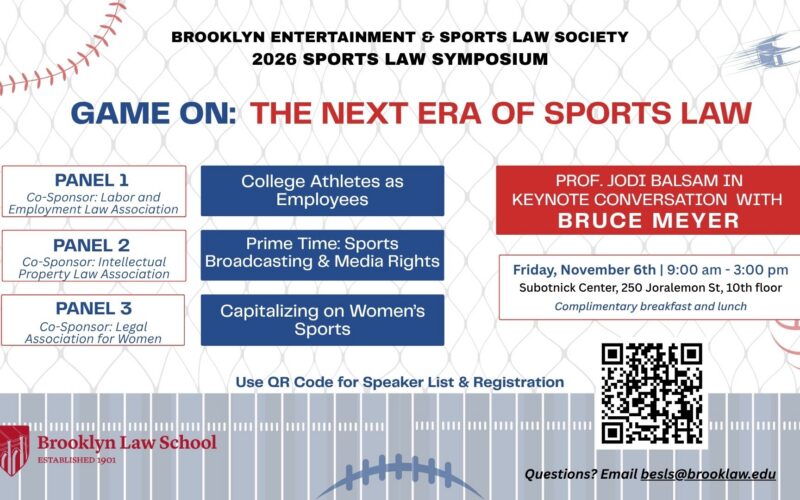
On Friday, November 6, 2026, the Brooklyn Entertainment and Sports Law Society (BESLS) hosted its sixth annual Sports Law Symposium, “Game On: The Next Era of Sports Law.” The symposium’s first panel, titled “College Athletes as Employees,” was co-sponsored by the Labor and Employment Law Association (LELA). LELA is a student organization that supports and connects students interested in labor and employment law, including adjacent practice areas like sports law, entertainment law, and in-house counsel. The panel provided an opportunity to explore the intersection of sports and employment law, particularly as the relationship between college athletes and their universities continues to evolve.
The panel was moderated by Brendan Duggan, BLS alumnus and an associate at Sheppard’s Labor & Employment group and featured panelists: Zachary L. Alexander, antitrust Associate at Winston Taylor; Brandon Copeland, a 10-year NFL veteran and co-founder of Athletes.org; Marc Edelman, the Director of Sports Ethics at the Robert Zicklin Center for Corporate Integrity; and Payton Sorci, Associate Counsel, Business & Legal Affairs at LIFT Management. With diverse backgrounds and professional experiences, each panelist shared their insights on the contested issue of whether college athletes should be treated as employees.
Making Progress
To provide context for the debate, Duggan opened the discussion by tracing the history of whether college athletes should be classified as employees and examining where the issue stands today. Edelman highlighted the complicated history of the “student-athlete” designation, dating back to the 1950s, and the significant progress made since then, such as the Northwestern football team’s 2014 attempt to unionize, the Dartmouth men’s basketball team’s union petition, and Johnson v. NCAA. In Johnson, the Third Circuit rejected the notion that college athletes’ amateur status categorically precluded them from qualifying as employees, opening the door for athletes to establish an employment relationship and seek minimum wages under the Fair Labor Standards Act.
With that foundation, the panel discussed the various arguments in support of categorizing college athletes as employees. Duggan focused on the revenue the players generate for the university, comparing the basic economic relationship to highly compensated professional athletes. Edelman illustrated this issue by pointing to the Ohio State Football Team. Despite the team’s biggest players bringing in revenue exceeding that of the nearby NHL’s Columbus Blue Jackets, the college athletes are not being compensated proportionally. Copeland—speaking from first-hand experience—highlighted the degree of institutional control exercised over college athletes, noting how coaches can influence decisions such as a player’s choice of major and schedule.
Sorci, who formerly worked in athletic department compliance, then volunteered to play devil’s advocate. He referenced the ideals the NCAA looks to maintain, like the competitive balance between teams that can and can’t pay and internal financial consequences. Specifically, universities unable to absorb the additional costs associated with employing athletes may be forced to reconsider their funding for non-revenue-generating sports. But he ultimately agreed with his co-panelists on the weakness of those positions.
Duggan continued to frame the discussion practically, questioning what classifying the athletes as employees would entail, garnering varied responses from the panelists. Alexander described the ideal, where all athletes would receive employee status. Edelman foresaw a compromise, where specific conferences, schools, and individual athletes would earn the status, according to their circumstances. Such an approach could account for the differences between athletes competing at major Division I programs and those competing at smaller institutions, where the financial realities may differ considerably. The panel concluded by fielding questions about the Protect College Athletes Act, which has passed in the U.S. Senate and is awaiting action in the House of Representatives. The panelists identified its Act’s potential to undermine the push for employment rights, and alternatives to that legislative approach.
Written by: Daniel Jaffe
Daniel is a 2029 J.D. Candidate at Brooklyn Law School.